.png)
Menu
Menu


Mechanical Ventilation with Heat Recovery continuously swaps stale indoor air for filtered fresh air, while keeping up to 90% of your heating. Essential for airtight, modern homes.
.png)







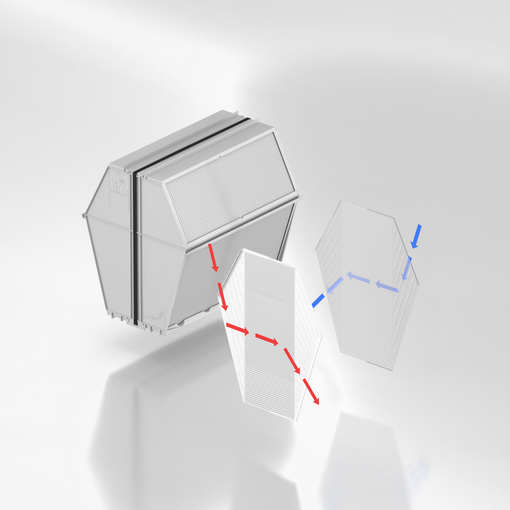
Inside the MVHR unit, a counter-flow heat exchanger transfers warmth from outgoing stale air into the incoming fresh air — without ever mixing the two streams. You get fresh air with almost none of the heating cost.

.png)
A domestic MVHR runs 24/7 and typically uses 20–40 W, costing roughly £40–£90 a year to run. In an airtight new-build it can save £100–£300+ a year on heating; in a leakier retrofitted home the savings are often much smaller.
If your property is a new build, a deep retrofit, or has an air permeability below around 5 m³/h·m², yes — Part F of the Building Regulations effectively requires a whole-house ventilation strategy, and MVHR is the most comfortable and efficient option.
Properly designed, no. At the unit we target below 35 dB, and at the supply valves you should hear nothing. Noise issues are almost always caused by undersized ducting or poor commissioning — we use rigid/semi-rigid ducts and balance every valve.
Very little. Filters are swapped every 6–12 months (you can do this yourself in two minutes) and the heat exchanger core is rinsed in the sink once a year. We offer an annual service plan if you'd rather we handle it.
A typical domestic MVHR installation runs £3,500–£8,000 for a 3–4 bed home, including unit, ductwork, valves, commissioning and certification. New builds sit at the lower end; retrofits cost more because of the extra work routing ducts through finished spaces.
Absolutely. MVHR doesn't lock you in — open the windows whenever you like. The system simply works less hard while they're open and returns to balanced ventilation when they're closed.
No — MVHR isn't a heating or cooling system. It recovers up to 90% of the heat from outgoing stale air and transfers it to incoming fresh air, so you lose far less warmth through ventilation. In summer, an automatic bypass diverts air around the heat exchanger so the house doesn't get pre-warmed, but it won't actively cool.
Yes, and we do it regularly. The bigger challenges are routing ductwork through finished ceilings or floor voids and improving airtightness so the system pays back — without those, performance suffers. We'll survey the property and tell you honestly whether it makes sense.
Yes — this is one of the biggest reasons people install it. MVHR continuously extracts moist air from kitchens, bathrooms and utility rooms before it has time to condense on cold surfaces, which is what causes black mould.
As standard, units come with G4 filters which catch dust, insects and larger particles. For pollen, PM2.5, traffic soot and finer allergens, we can fit F7 or ePM1 filters on the supply side on request — a worthwhile upgrade for anyone with hayfever, asthma, or living near busy roads.
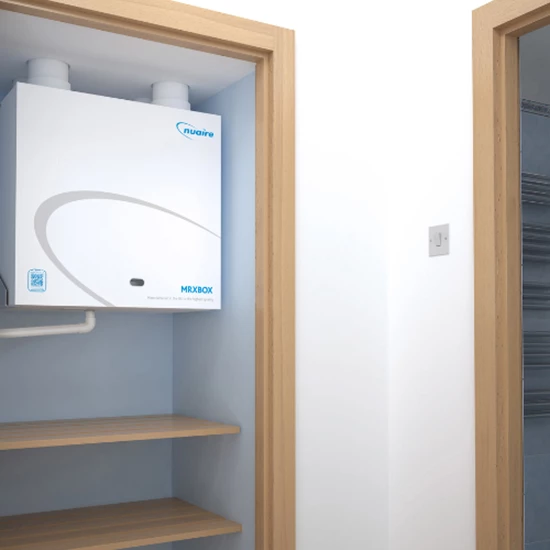
The unit is roughly the size of a tall fridge cupboard (typically 600–700 mm wide and 700–900 mm tall) and lives in a loft, utility room, plant room or airing cupboard. It needs power, a condensate drain, and access for filter changes — we'll find the best spot during the survey.
A well-installed MVHR system lasts 15–20 years, and the heat exchanger core itself has no moving parts. Manufacturer warranties are typically 2–7 years on the unit, plus our own workmanship guarantee on the installation.


.png)


